
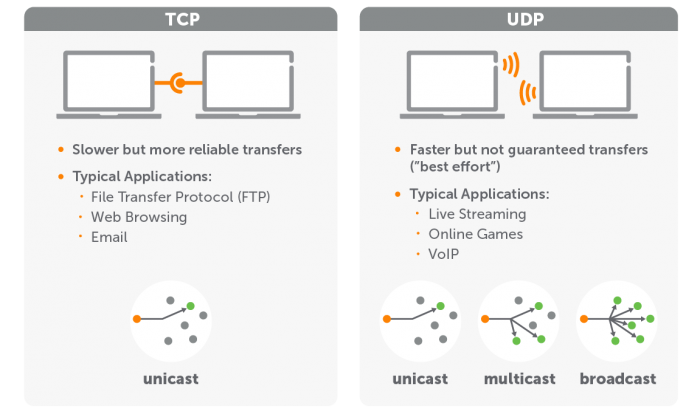
At the heart of the modern internet lie two transport protocols with very different design philosophies: TCP (Transmission Control Protocol) and UDP (User Datagram Protocol). Both operate at the transport layer of the TCP/IP model, yet they are optimized for fundamentally different goals. Understanding why web traffic relies on TCP while real-time applications favor UDP requires looking beyond definitions and into how networks behave under real-world conditions.
This distinction is not theoretical. It directly shapes the performance of websites, live video platforms, online games, and interactive media systems used daily by billions of people.
Transport-layer design goals
Transport protocols exist to move data between applications running on different machines. The key design question is not “how fast can data be sent,” but rather what guarantees the application needs.
Broadly speaking, applications fall into two categories:
- Correctness-oriented applications, where all data must arrive intact and in order.
- Timeliness-oriented applications, where arriving late is worse than arriving imperfectly.
TCP and UDP sit on opposite ends of this spectrum.
Why TCP is well suited for web traffic
Web traffic, including HTTP and HTTPS, is fundamentally stateful and correctness-sensitive. A webpage is not a stream of interchangeable data. It is a structured collection of resources that must be received exactly as sent.
Reliability and guaranteed delivery
TCP provides reliable delivery through acknowledgments and retransmissions. When a packet is lost, TCP detects the loss and resends it. This behavior is essential for web content. A missing fragment of HTML, CSS, or JavaScript is not a minor inconvenience; it can prevent an entire page from rendering correctly.
From an application standpoint, TCP allows developers to assume that data either arrives correctly or not at all, eliminating the need for custom error recovery at the application layer.
Ordered data delivery
TCP preserves byte order. Even if packets arrive out of sequence, TCP reassembles them before delivering data to the application. This is critical for web traffic, where the semantic meaning of content depends on correct ordering.
For example, receiving the end of a JavaScript file before its beginning is meaningless. TCP ensures that this never happens from the application’s perspective.
Congestion control and network stability
Another often overlooked aspect of TCP is congestion control. TCP dynamically adjusts its sending rate based on network conditions. When congestion is detected, TCP slows down. This behavior protects the wider internet from collapse during peak usage.
For web traffic, this trade-off is acceptable. Users may tolerate a slightly slower page load, but they will not tolerate broken or incomplete content.
Why UDP excels in streaming and gaming
Real-time applications face a different problem. In live streaming, video conferencing, or online gaming, late data is useless.
A video frame that arrives after its playback deadline has no value. A delayed player position update in a game can be more disruptive than a missing one.
UDP is designed with this reality in mind.
No retransmissions, minimal latency
UDP does not retransmit lost packets and does not wait for acknowledgments. This dramatically reduces latency. The protocol simply sends data and moves on.
For real-time systems, this behavior is a feature, not a flaw. Waiting for retransmissions introduces jitter and delay, which degrade user experience far more than occasional data loss.
Application-level intelligence
With UDP, responsibility shifts from the transport layer to the application layer. Modern streaming and gaming systems are designed to handle loss gracefully:
- Video codecs interpolate missing frames.
- Audio systems conceal packet loss.
- Game engines predict player movement between updates.
This approach allows applications to optimize for perceived smoothness rather than mathematical perfection.
Predictable timing over perfect accuracy
In real-time systems, consistency matters more than accuracy. UDP provides predictable timing by avoiding the stop-and-wait behavior inherent in TCP. This predictability is why most live streaming protocols, real-time communication systems, and online games rely on UDP-based transport.
The practitioner’s perspective: why this matters in real systems
In production streaming environments, the difference between TCP and UDP is immediately visible.
TCP-based streaming often suffers from buffering cascades under packet loss. A single lost packet can stall playback while the protocol waits for retransmission. UDP-based streaming, by contrast, may briefly degrade quality but continues playing.
From an operational standpoint, UDP allows systems to scale more effectively under fluctuating network conditions, especially across mobile networks, international links, and congested last-mile connections.
This is why modern real-time platforms increasingly favor UDP at the transport layer, even when they add reliability mechanisms on top.
Modern convergence: reliability over UDP
The distinction between TCP and UDP is no longer absolute. Newer protocols such as QUIC, used by HTTP/3, run on top of UDP while reintroducing selective reliability, encryption, and congestion control at the application layer.
This evolution reflects a broader industry realization: UDP provides a flexible foundation, while reliability should be applied only where it is truly needed.
Conclusion
TCP and UDP are not competing protocols. They are complementary tools designed for different problem spaces.
TCP prioritizes correctness, order, and stability, making it ideal for web traffic. UDP prioritizes speed and timeliness, making it indispensable for streaming, gaming, and real-time communication.
Understanding this distinction is essential for anyone working with modern internet applications, especially in live media and interactive systems.